Wednesday, July 5, 2017

BIRD NEWS:349


A video ends my Arundel excursion taken late May. The video shows either courtship/mating behaviour or some such display of a blue beaked duck.

Back home, and Bubster Pidge lazed on the sill with what was left of my birthday flowers from Liz.


Late May and Early June had the garden filled with an abundance of baby birds. My next set of photographs were taken of the blue tit family - second lot - from the nesting box. This was the first time I had seen the youngsters out of the box, and here they were hanging round the feeder pole with parents...


...learning how to feed for themselves, but mostly waiting to be fed with that familiar 'wing-flap/beak open' stance that many birds have at that age.

Saturday, July 1, 2017

BIRD NEWS:348


I took 2 more shots of the swallow - but it did not come out as well as last year. Although last year I kept getting my best friend's head in the shots too. Next up, some information on herons.


Back at the feeder station, pigeons were still hanging out with the ducks. I next caught sight of a Baikal teal - and took a shot of the info board to remind me what it was I was taking photo of.


My last shot turned out the best coloring wise, I think.


Towards the end of my late-May trip, I got 2 good shots of the Australian woodducks. Here you can see a pair - and yes, the male is the one with the darker brown head!! That brings us almost to the close of that excursion, but not quite to the month of May.


BIRD NEWS:347


We start today's write-up with some more photos of the shelduck family taken through the hide window. Here are the youngsters...


...swimming not too far from parent bird. They looked a little like feathered swimming zebras when their beaks were under water.


Parent duck took a good look at me and my camera - perhaps it was because the camera was the pink one.


Hanging out with the aquatic birds was a lazing pigeon at the next pond I passed!

Tuesday, June 27, 2017

BIRD NEWS:346


Today, we start with the eider ducks. They were sighted on each of my three circles of the reserve in late May. Mostly, they stayed on the farside bank, but this pair went for a swim.


Looking up at the cafe roof as I came through between circles 2 and 3, I spotted some pigeons! On my third and final circuit for this trip, I caught a couple of shots of the diving ducks obtaining food.


Their feeding station allows them to tap at the yellow tag which in turn allows a few pellets of food to fall for the ducks to munch from the surface of the water. As I circled my final time for this trip, I caught some better shots of the shelduck family.

They were swimming nearer to the hide window on this circuit, so I was able to get some better pictures of the young ones.

Saturday, June 24, 2017

BIRD NEWS:345


Geese and ducks were not the only youngsters on site. Here is a young moorhen wandering along the pathway after the parent and its siblings. Next up, a bunch of birds gathered under the feeder station. The group includes jackdaws and ducks, a moorhen, a passing coot - and pigeons!


After several trips without spotting the blacknecked swan, I finally managed to capture it on camera again. My first shot was of it beginning to preen as it swam about the lake. It then went into a frenzy and nipped and nibbled away chaotically - I can only assume it had something akin to a flea that it wanted to be rid of as it splashed and nipped and swam in crazy circles.


Finally it calmed down a little and swam away with a splash and shudder before returning to its usual graceful motions.


A pair of American woodducks were in the same location for me to photograph. The male is the colorful bird, as is generally the case with ducks. Finally for todays' post some information about bluetits. We have some in our nesting box currently - second family of the year.

Thursday, June 22, 2017

BIRD NEWS:344


One last shot of the shelduck family - for now. Moving on, another information board appeared. I photograph these as well as the living birds in order to remember the information given as well as to share it with readers.


Oh look - on my way to the woodland hide I encountered yet another goose family wandering hissfully about. Inside the hide, I spotted yet another family; this group were learning to eat fallen seed pieces as the chaffinches and tits above dropped spillage below for them whilst messily munching.


Yet another family of geese wandered along the pathway, almost in single file, to join the bunch at the feeders. Below, you can see the arrangement - where geese munch fallen food while a chaffinch eats above dropping crumbs.


Later on, sleepy mallards replaced the geese. I in fact circled the reserve 3 times on this occasion in late May. I was on an all day excursion, so it was not just a coffee and single circuit wandering with perhaps a boat trip or lunch thrown in on this occasion. There were young ducks too.

Wednesday, June 21, 2017

BIRD NEWS:343 and the whitethroat


Starting today's post, here are the Bewick swans again, hanging out around their 2017 nest with a few ducks in attendance. I walked along the pathway - only to encounter another bunch of geese and goslings.

They were sitting right in the middle of the path and it was difficult to get past without being hissed at - as though they thought they owned the right of way rather than shared it equally.

Here is a map of the entire reserve. I thought it might be of interest to regular readers who are unable to attend in person seeing as I post quite a few pictures from Arundel WWT. I generally start at the visitors center, turn left and do a clockwise circuit - sometimes stopping for coffee first and sometimes taking the left leg as well as the circle track. I generally skip Sussex screen and go around the reedbeds.

Here are the Trumpeter swans - they are also nesting. Last year they hatched a whole bunch of young ones - which mysteriously vanished a month or two ago. Swans take 2 years to loose their gray plumage and become white adults, but these youths vanished at 1 year of age - so I am assuming it is part of a breeding program and there is a call for another batch to be born already.

In the reedbed hide last year's swallow appears to have returned to its old nesting haunt.


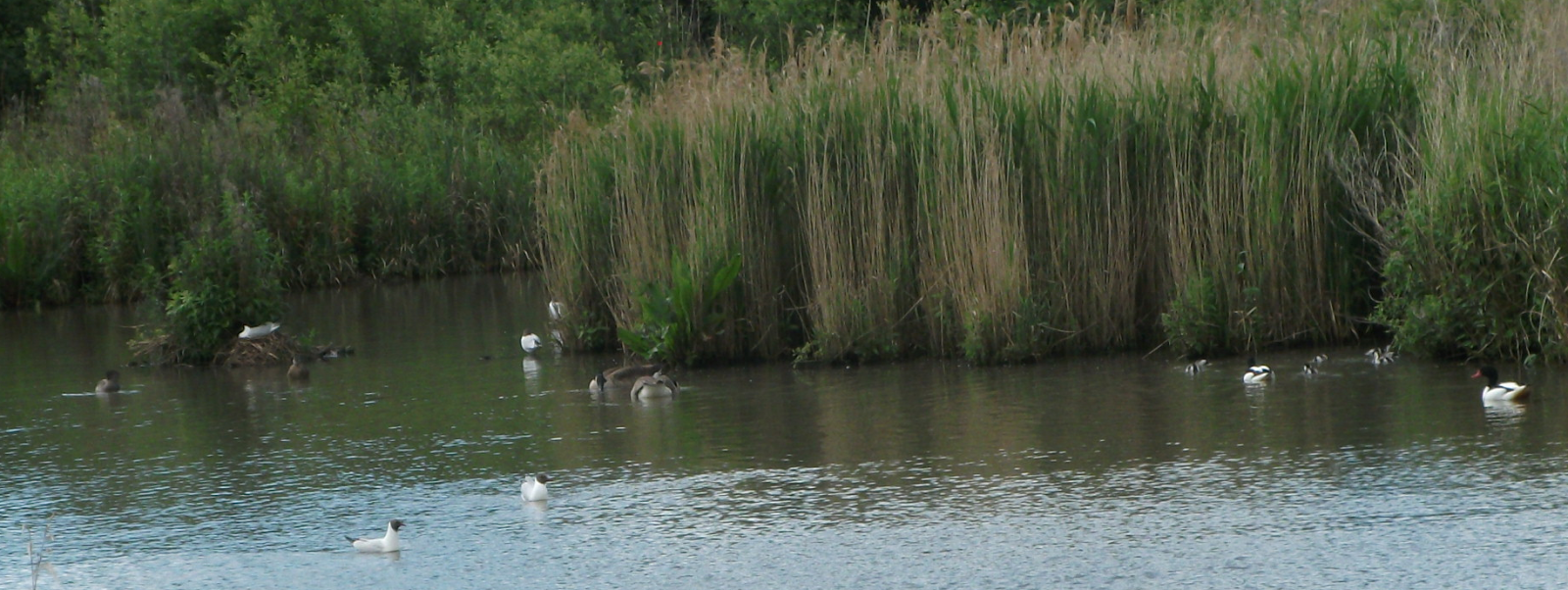
Almost ending today's post, I caught sight of a group of shelducks - 5-6 young with a parent - floating about at one hide.

Finally, HERE is a link to some info on a bird we do not seem to have in our area...